
Check Engine Light On? What It Means and How to Read the Code
A trouble code names a symptom, not always the failed part. Here's how to read it correctly before you order a replacement.
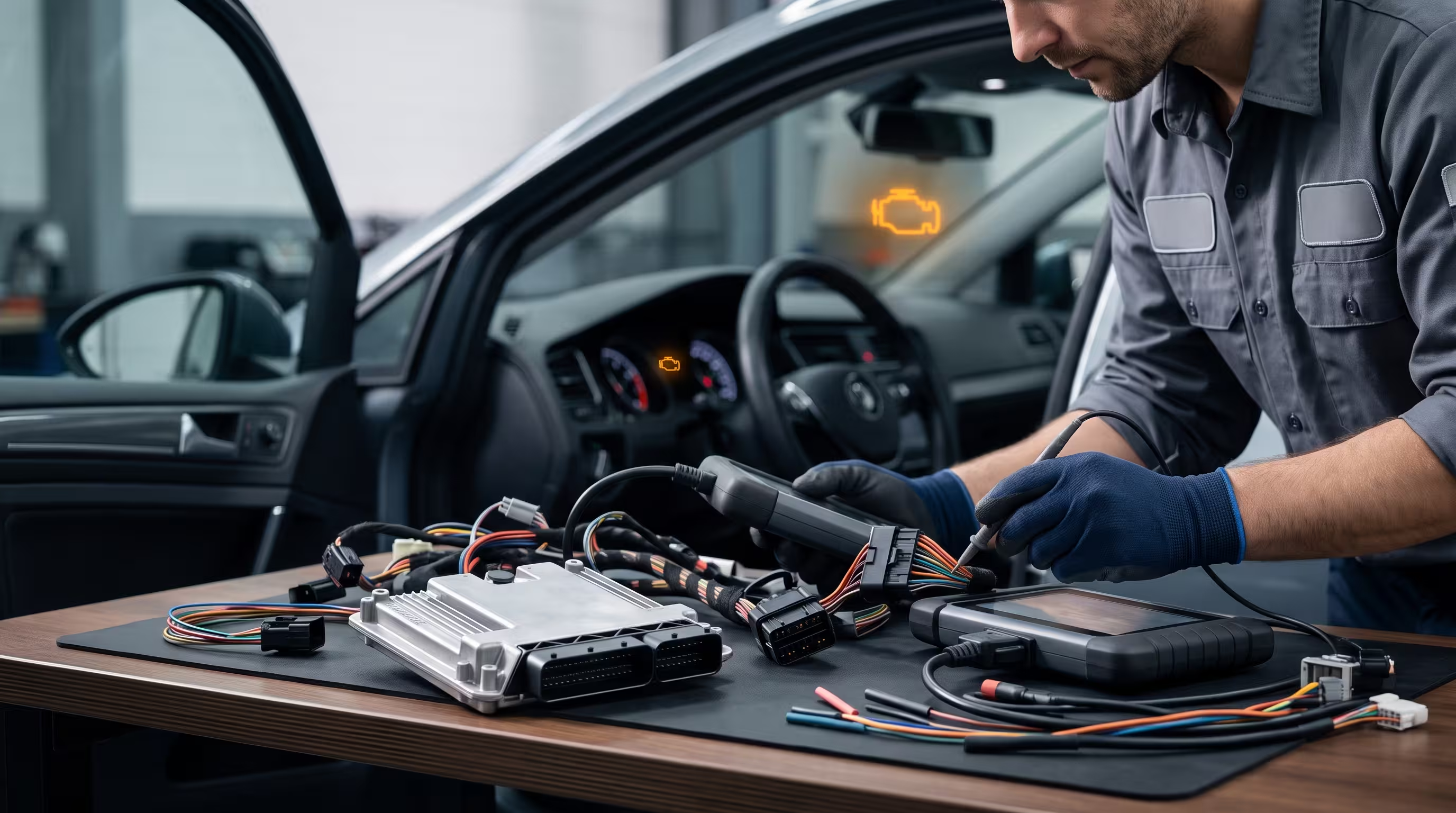
What a check engine light means, how to read the OBD-II code yourself, when it is safe to drive, and how to avoid replacing the wrong part. It is written for buyers, DIYers, and workshops who want clearer technical context, more reliable fitment checks, and fewer avoidable mistakes.
In this guide
Read the code before you touch a wrench
An OBD-II code is a five-character clue, not a part number - the plug-in port is under the dash near the pedals on every car built since the mid-1990s.
Every vehicle sold since the OBD-II mandate has a female 16-pin trapezoidal port, almost always under the driver's side of the dash near the pedals. Plugging in a code reader returns one or more codes in a letter-plus-four-digit format: a P prefix means powertrain (engine/transmission), B means body, C means chassis, and U means network/communication. The first digit after the letter tells you whether it's a generic SAE code (0) or manufacturer-specific (1); the remaining digits identify the system and specific fault.
If a scan returns multiple codes, work from the top of the list down rather than chasing whichever one sounds scariest - later codes on the list are frequently downstream symptoms of the first one, not separate failures. Clearing codes and seeing which ones return after a drive cycle is a legitimate way to separate a live fault from a one-off sensor glitch, but only after you've noted what was originally stored.
- OBD-II port: female 16-pin trapezoidal connector, typically under the dash near the pedals.
- P-codes = powertrain, B = body, C = chassis, U = network/communication.
- Address the first code on the list first - lower codes are often downstream symptoms.
The most common codes, and what they actually mean
A handful of P0300-series and sensor codes account for a large share of check-engine-light visits.
P0300 signals a random or multiple-cylinder misfire; P0301 through P0308 pinpoint a specific cylinder (P0301 is cylinder 1, and so on). A misfire code doesn't by itself tell you whether the cause is a spark plug, ignition coil, fuel injector, or a vacuum leak feeding that cylinder - it tells you where to start looking, in that rough order of likelihood and cost. Oxygen sensor and catalytic converter efficiency codes (the P0130-P0169 and P0420-P0430 ranges) are also extremely common, and both can be triggered by a genuinely failed sensor or by an unrelated upstream problem, such as an exhaust leak, feeding the sensor bad data.
This is the single most common mistake in DIY diagnosis: replacing the part named by the code before checking whether something upstream is actually causing it to read incorrectly. A catalytic converter code, for example, is frequently caused by a failing oxygen sensor or an exhaust leak rather than a genuinely dead catalytic converter - and a catalytic converter is a far more expensive part to replace on a guess.
- P0300-P0308: misfire codes, ranked by cylinder - check plugs/coils/injectors for that cylinder first.
- P0130-P0169: oxygen sensor circuit codes.
- P0420-P0430: catalytic converter efficiency - verify sensors and exhaust integrity before replacing the converter itself.
When to buy a part vs when to keep diagnosing
Confirm the code with a second data point before ordering the named part.
A code reader that also shows live sensor data (freeze-frame data captured at the moment the code triggered) is worth the small extra cost over a basic reader, because it lets you check whether the reported values make physical sense - a wildly out-of-range oxygen sensor reading is a stronger signal than the code alone. Where possible, a visual inspection of accessible components (vacuum lines, connector corrosion, obviously worn ignition coils) before ordering anything can save a wrong-part purchase entirely.
Once you've narrowed the cause to a specific part, confirming exact fitment matters more on electronically coded components (sensors, ECUs, ignition modules) than on purely mechanical ones, since some of these parts carry software or calibration dependencies tied to your specific engine code and model year - not just the model name. A VIN-based lookup resolves that build-level detail directly rather than leaving it to a generic year/make/model filter.
- A reader with live/freeze-frame data helps confirm a code rather than just naming it.
- Visually inspect accessible components before ordering a replacement part on a guess.
- For sensors and electronic modules, confirm fitment against your VIN - coding/calibration dependencies are common.
Related site resources
These links point to supporting resources such as FAQs, category references, and contact forms when extra context is useful.
FAQ
Is a check engine light serious?
A steady light means a fault has been stored and should be checked soon. A flashing light usually means a severe misfire that can overheat and damage the catalytic converter, so reduce speed and stop driving as soon as it is safe.
Can I drive with the check engine light on?
A steady light usually means it's safe to drive to get it checked soon, but a flashing check engine light indicates an active misfire that can damage the catalytic converter and should be addressed immediately, not driven on.
Will disconnecting the battery clear the code?
It can clear the stored code temporarily, but it doesn't fix the underlying fault - if the condition is still present, the code (and the light) will return, usually within one to a few drive cycles.
Do auto parts stores read codes for free?
Many do offer free code scans, which is a reasonable first step - just treat the code as a starting point for diagnosis, not an automatic instruction to buy the named part.