
Opel Astra & Zafira ECU and Sensor Failures: Symptoms and Fixes
Use this diagnosis-first workflow to reduce parts swapping and identify when a tested replacement ECU or sensor is justified.
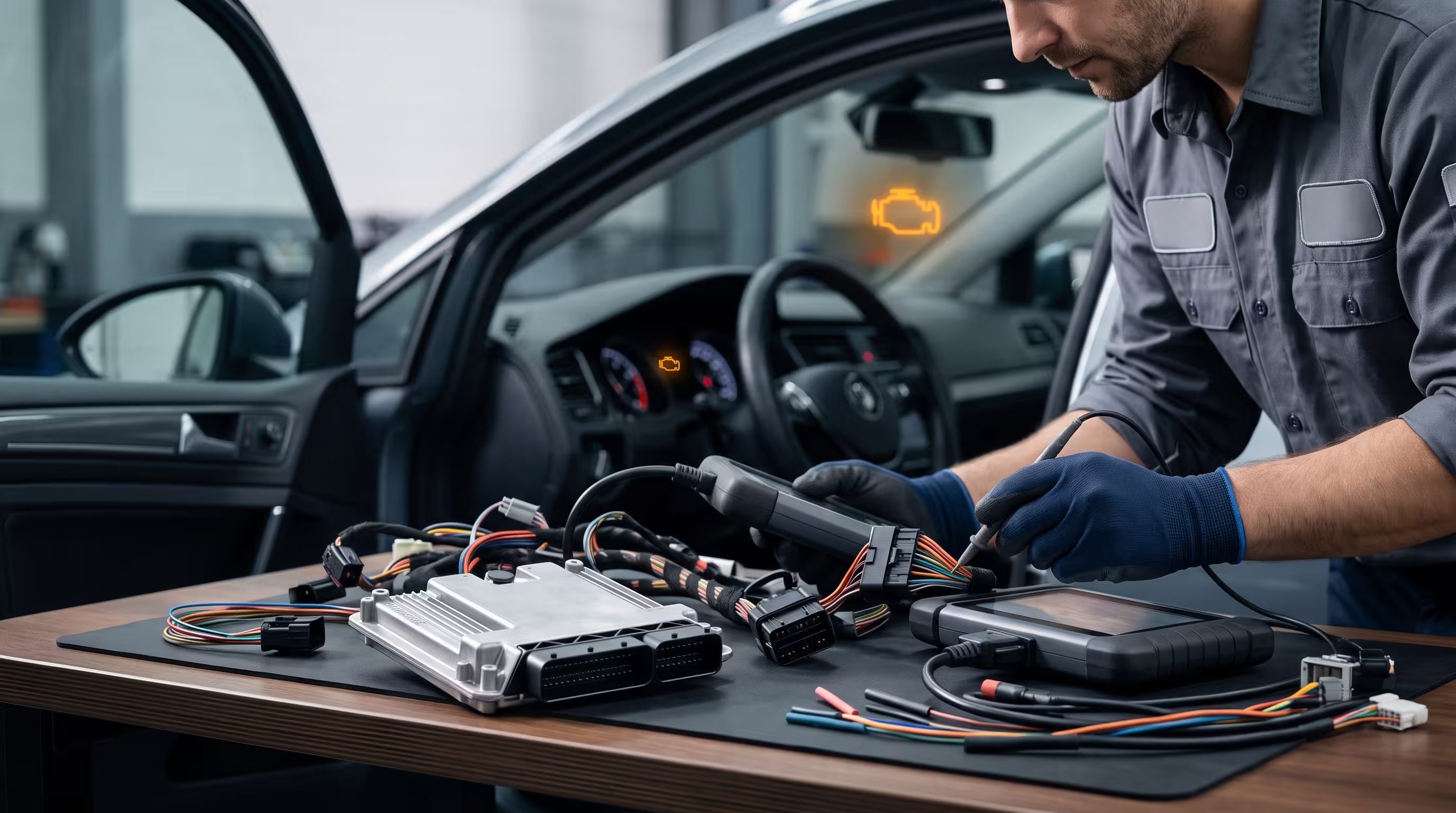
ECU and sensor failure symptoms on the Opel Astra and Zafira, how to tell a failing ECU from a bad sensor or battery, and what replacing an ECU involves. It is written for buyers, DIYers, and workshops who want clearer technical context, more reliable fitment checks, and fewer avoidable mistakes.
In this guide
First checks before replacing components
Fault code context and basic electrical checks should come before major component replacement decisions.
Modern engine management systems can create misleading symptoms when voltage supply, grounds, or network communication are unstable. A warning light and a module-related code do not automatically prove module failure. ECM guidance from repair literature repeatedly shows that software issues, shorted circuits, charging faults, and corroded connectors can all imitate a failed unit or trigger companion faults that send diagnosis in the wrong direction.
That is why the first pass should be boring and disciplined: preserve freeze-frame data, confirm battery and charging health, inspect harness routing, and verify whether the fault is repeatable. A module should be condemned only after the basic electrical environment has been checked, because replacing a control unit without solving an upstream voltage or wiring issue often creates the illusion of repair before the same fault returns.
- Scan for stored and pending DTCs and preserve freeze-frame data.
- Inspect grounds, connectors, and harness pinch points before condemning ECU hardware.
- Confirm battery and charging stability to prevent false electronic fault chains.
When ECU replacement is justified
Replacement becomes logical when repeatable diagnostics indicate module-level failure after wiring and power validation.
True ECU failure usually reveals itself through repeatable behaviour that survives the obvious checks. That can mean a no-start with verified power and ground, a unit that will not communicate while the rest of the network is healthy, or persistent output-circuit faults that remain after the load side and wiring have been proven. The logic is not "the car runs badly, therefore the ECU is bad." The logic is that the ECU becomes the last credible fault point once everything around it has been ruled out.
Replacement planning should start before the part arrives. On many Opel and wider European platforms, the real job is not just the module swap but the immobilizer alignment, software compatibility, coding, and post-install validation. A tested used module can be sensible, but only if the hardware index, part number family, and programming path are known upfront rather than improvised on installation day.
- Match part number and hardware index exactly where possible.
- Plan immobilizer alignment or coding steps before ordering.
- Use tested modules with documented provenance to reduce DOA risk.
NOx and emissions sensor strategy
Sensor replacement works best when upstream causes are controlled and adaptation procedures are completed.
Emissions sensors fail in a system, not in isolation. Heat, exhaust leaks, contamination, wiring strain, and failed regenerations can all distort sensor behaviour or shorten service life. Replacing a NOx or related emissions sensor without checking the surrounding exhaust path can clear a code briefly while leaving the real cause untouched, which is why repeat failures are so common on poorly diagnosed diesel jobs.
The practical test is whether the repair changes the live behaviour of the system, not just whether the warning lamp disappears. A complete sensor job should include inspection of the wiring in heat-exposed areas, confirmation that adaptation procedures run successfully, and some evidence from post-repair data that the engine management system is once again seeing believable values.
- Check exhaust leaks and wiring continuity near heat zones.
- Validate live data behavior after replacement instead of clearing codes only.
- Document adaptation success to avoid repeat fault returns.
Replacement validation after installation
Post-install validation determines whether the repair is complete or only symptom-masked, especially for intermittent ECU and NOx faults.
The most common mistake after an ECU or sensor replacement is assuming that a clean start and no immediate warning lights equals a finished repair. Many electrical and emissions faults are temperature-sensitive, vibration-sensitive, or dependent on a complete drive cycle. If the module powers up and the car idles, that only proves the first stage of the repair was successful.
A proper validation sequence closes the loop: clear and rescan faults, confirm readiness behaviour, observe live data through a controlled heat cycle, and perform a short road test that exposes the system to real load. Without that sequence, a repair may look successful in the workshop but fail again once the car sees motorway temperature, restart cycles, or sustained electrical load.
- Run a complete fault scan and compare against pre-repair DTC snapshots.
- Verify live data stability through cold start, idle, and controlled load conditions.
- Confirm that adaptation and coding jobs complete without pending faults.
- Perform a short road test with re-scan to catch heat-cycle related returns.
External reference images
These images are hosted by their original publishers. Each image includes a direct source link for attribution and context.

Opel exhaust sensor system visual
View original source
ECU symptom and replacement context
View original sourceRelated site resources
These links point to supporting resources such as FAQs, category references, and contact forms when extra context is useful.
FAQ
How much does ECU replacement cost?
It varies widely by car and by whether the unit is new, used or repaired. A used ECU costs far less than a new one, but most need coding or programming to the car's immobiliser and VIN, so get quotes that include the programming.
Can a bad battery trigger ECU-like faults?
Yes. Low voltage and charging instability can create wide electronic fault patterns that mimic module failure.
Do I need coding for a replacement ECU?
In most cases, yes. Immobilizer synchronization and configuration coding are usually required.
Should I replace sensors and ECU at the same time?
Not by default. Use staged diagnostics so each replacement is evidence-based and measurable.