
European VIN Decoding: How to Find the Model and Engine Code
Decode a US-market VIN and you get the model, engine and trim. Decode a European one and you often get the maker and the year. Here is why, and where the missing details are.
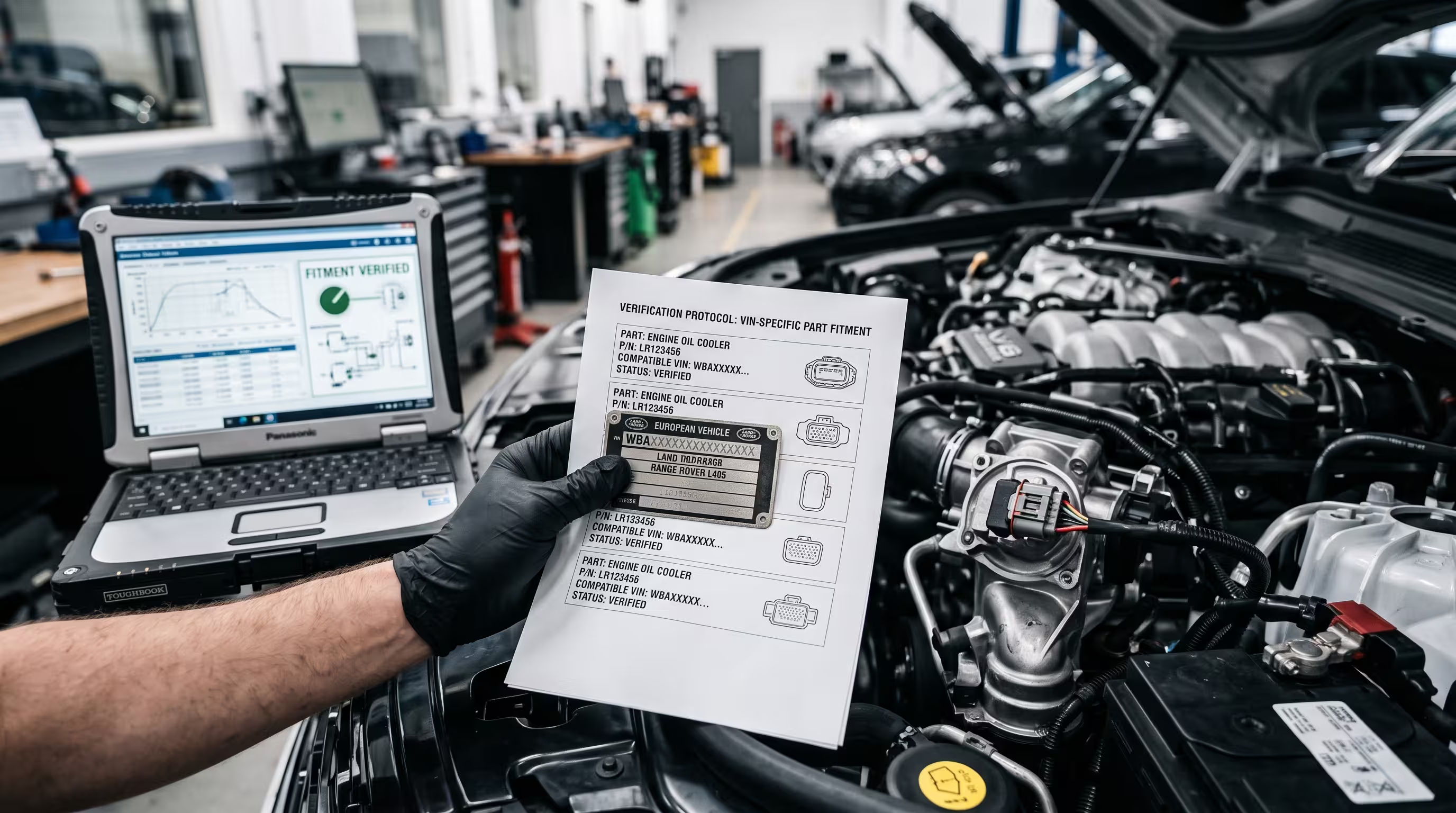
Why European VINs decode to little more than the make and year, how to read VW, Audi and BMW VINs by hand, and where to find the engine code instead. It is written for buyers, DIYers, and workshops who want clearer technical context, more reliable fitment checks, and fewer avoidable mistakes.
Try your own VIN first. The decoder shows what can be read from it, and this guide covers the rest.
Open the free VIN decoderIn this guide
Why a European VIN decodes to so little
North American rules say what most of the 17 characters must mean. European rules mostly do not, so the details a decoder looks for are often not there.
Every modern car carries a 17-character VIN in the ISO 3779 format, but the format only fixes the outline. In the United States and Canada, federal rules (49 CFR Part 565 in the US) go further: positions 4 to 8 must describe the vehicle, typically the line, series, body type, engine and restraint system, position 9 must be a check digit, position 10 the model year and position 11 the assembly plant. That is why a free decoder can turn a US-market VIN into a model, an engine size and a trim level.
Vehicles built for Europe only have to carry a unique 17-character number with the manufacturer code at the front. What goes in the middle is up to the manufacturer, and many fill it with the letter Z or use their own internal codes. Run one of these VINs through a decoder and it can usually name the maker, the country of manufacture and often the model year, but not the model, engine or trim. Nothing is wrong with the VIN or the decoder; the information was simply never encoded.
- Positions 1-3 (the manufacturer code) are meaningful on every VIN, European or not.
- Positions 4-8 carry model and engine details on North American vehicles, but are often filler on European ones.
- A US-market BMW or VW decodes in far more detail than the same model sold in Germany.
Reading a VW or Audi VIN by hand
Volkswagen Group VINs follow a consistent pattern: filler Zs, a two-character model code, the model year and the factory.
Take WVWZZZ1JZ3W386752. WVW is Volkswagen passenger cars. ZZZ in positions 4 to 6 is filler. Positions 7 and 8, 1J, are the model code, here the fourth-generation Golf and its relatives. Position 9 is another Z. Position 10, 3, is the model year 2003, and position 11, W, is the Wolfsburg plant. The last six characters are the serial number.
Audi works the same way. In WAUZZZ4F06N012345, WAU is Audi, 4F is the C6-generation A6, 6 is 2006 and N is the Neckarsulm factory. The model code is the useful part for a parts buyer: it tells you the platform generation, which is exactly what separates an A6 4F seat or headliner from one for the earlier 4B or later 4G. It does not tell you the engine, the gearbox or the trim, and for those you need the vehicle data sticker described below.
- WVW, WAU, TMB and VSS are Volkswagen, Audi, Skoda and SEAT manufacturer codes.
- Positions 7-8 are the platform or model code, for example 1J, 1K or 4F.
- Position 10 is the model year and position 11 the factory.
Where the engine code and options really are
On many European cars the build details live on a data sticker, in the registration document and on the engine itself, not in the VIN.
Volkswagen Group cars carry a vehicle data sticker, usually in the spare-wheel well and repeated in the service book. It lists the VIN, the engine code, the gearbox code, the paint code and a block of three-character option codes, often called PR codes, that record equipment such as brakes, seats, lighting and suspension. If you are buying anything that varies by specification, a photo of that sticker is worth more than the VIN alone.
EU registration certificates follow a harmonised layout. Field E is the VIN, D.1 the make, D.2 the type, variant and version, D.3 the commercial name, P.1 the engine capacity, P.3 the fuel type and, where it is filled in, P.5 the engine identification number. The engine code is also stamped or labelled on the engine block. For BMWs, parts catalogues accept the last seven characters of the VIN and return the full factory build, which makes BMW one of the easier European makes to match.
- Photograph the vehicle data sticker in the spare-wheel well or service book if your car has one.
- Check fields D.2, P.1, P.3 and P.5 on the registration certificate.
- Read the engine code from the block or the engine cover label for engine and gearbox parts.
Putting it together before you order
Use the VIN to confirm the maker, platform and year, then match the part number on the old part.
For used European parts the most reliable match is the part number printed on the old part, checked against the platform the VIN confirms. The VIN rules out the obvious mistakes: a part for the wrong generation, the wrong model year or a car built in a different market. The part number and the data sticker settle the details the VIN cannot, such as which of several engines, seat frames or wiring looms the car was built with.
If you cannot get at the old part, send us the VIN with a photo of the data sticker or registration document and we will check a listing against it before you buy. That is quicker than a return, and on parts such as seats with airbags, engines and electronics it avoids an install that cannot work.
- Decode the VIN to confirm make, platform code and model year.
- Match the part number on the old part, or the engine and option codes on the sticker.
- Ask for a fitment check when the part is expensive, safety-related or electronic.
Comparison table
What a decoder can usually read from a VIN
| Detail | US and Canadian market | European market |
|---|---|---|
| Manufacturer and country | Yes | Yes |
| Model year | Yes | Usually |
| Assembly plant | Yes | Usually |
| Model or platform | Yes | Sometimes, as a maker's code |
| Engine | Usually | Rarely |
| Trim and options | Sometimes | No, check the data sticker |
Related site resources
These links point to supporting resources such as FAQs, category references, and contact forms when extra context is useful.
FAQ
What does ZZZ mean in a VIN?
It is filler. Volkswagen Group and some other European makers put Z in characters that their market does not require to carry information. It is normal and does not mean the VIN is fake or damaged.
Can I find the engine code from a European VIN?
Rarely from the VIN alone. Look on the vehicle data sticker, in field P.5 of the registration certificate if it is filled in, or on the engine block itself.
Why does an online VIN decoder show my car as a different model?
Some decoders guess the model from the manufacturer code and year when the VIN itself does not say. Treat a model shown for a European VIN as a hint, and confirm it against the model code in positions 7-8 or your registration document.
Is the model year always in position 10?
On North American vehicles, yes. Many European makers, including Volkswagen and Audi, use position 10 the same way, but it is not required, so check the date of first registration if the year looks wrong.