VIN Number Lookup for Parts: Check Fitment Before You Buy
Fitment mistakes are expensive. This guide shows a repeatable VIN-first process that helps buyers choose the right part the first time.
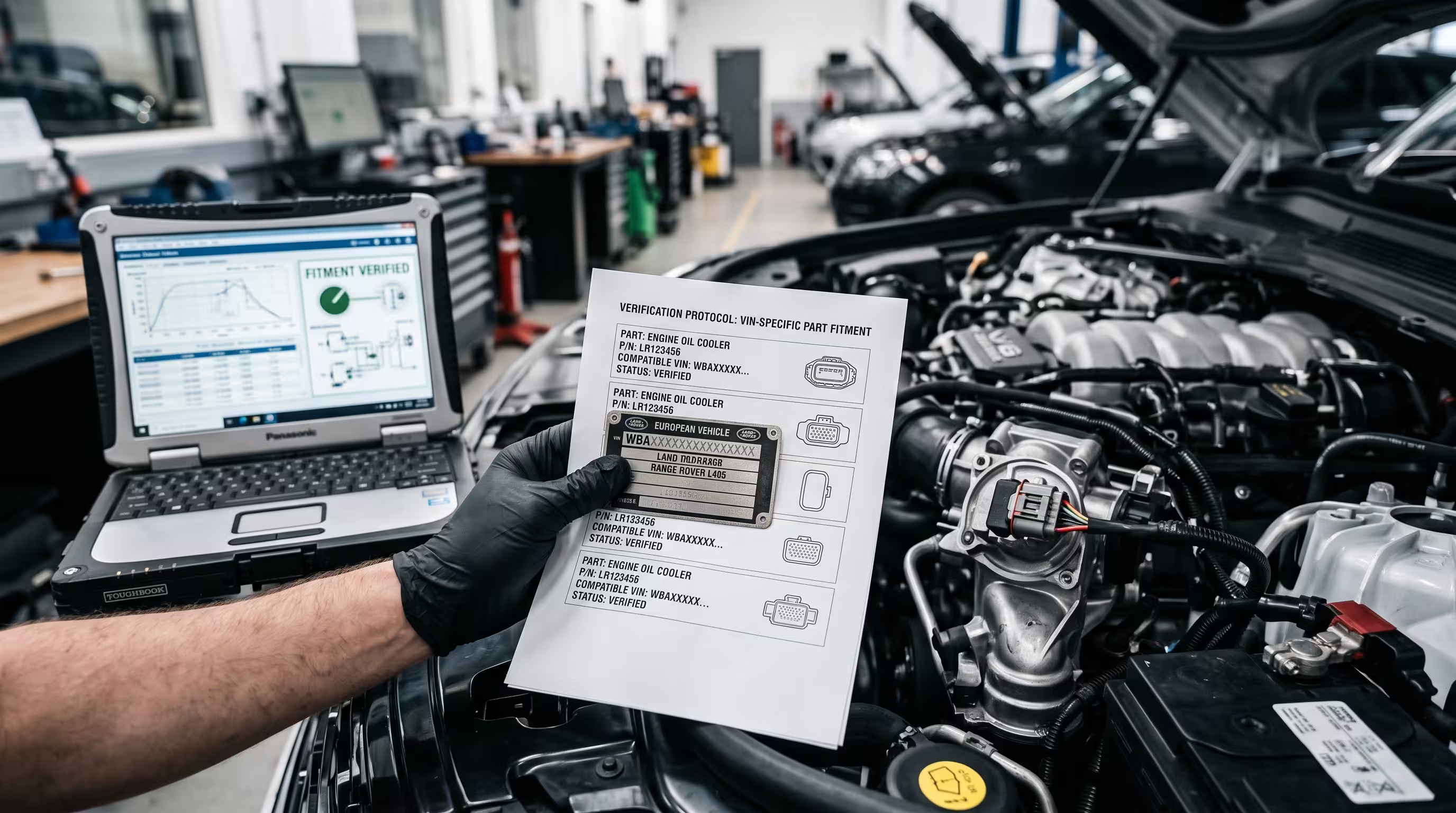
How to use a VIN number lookup to find parts that fit: decode the VIN, match the engine code and part number, and avoid ordering the wrong part. It is written for buyers, DIYers, and workshops who want clearer technical context, more reliable fitment checks, and fewer avoidable mistakes.
Have your VIN to hand? Decode it now to see the make, model, year and engine before you compare part numbers.
Open the free VIN decoderIn this guide
Why VIN-first search reduces wrong-part orders
A VIN provides model generation, drivetrain context, and trim information that broad make-model filters often miss.
A full 17-character VIN is the closest thing a parts buyer has to a factory build sheet. It helps separate two vehicles that look identical on the driveway but left the assembly line with different engines, braking packages, restraint systems, or mid-year revisions. That matters most on European platforms, where one model year can hide several specification splits that never show up in a basic year-make-model search.
Research from VIN-decoding guidance and the NHTSA vPIC system reinforces the same point: the VIN is strong at identifying factory configuration, plant, model year, and core vehicle descriptors, but it is not a substitute for checking the actual component when a car has been modified after delivery. A smart fitment workflow uses the VIN as the baseline, then confirms the old part number, connector style, and production details before ordering anything fitment-critical.
- Confirm the 17-digit VIN and validate that characters were copied correctly.
- Cross-check VIN output with the existing part number or stamped engine code.
- Use a final compatibility check for body style and production month before purchase.
What to do if the VIN is missing
No VIN does not block sourcing if you collect enough fallback identifiers in the correct order.
Missing VIN data is inconvenient, but it should not force guesswork. In practice, experienced dismantlers and workshops fall back to a hierarchy of identifiers: engine code, gearbox code, OEM part number, production date, connector geometry, and mounting details. That evidence chain is often enough to narrow down the correct part family, especially when the failure item is already removed from the vehicle and can be photographed clearly.
The key is to replace vague descriptions with hard identifiers. Saying "I need an Astra ECU" is rarely enough, while providing the module label, hardware revision, engine code, and two clear wiring photos usually is. This is also where buyer mistakes happen most often: the less exact the evidence, the more likely a listing photo or generic description gets trusted when the actual electrical or mechanical variant is different.
- Capture engine code, gearbox code, and current part numbers from labels or castings.
- Photograph connector type, mounting points, and sensor positions to avoid variant mismatch.
- Submit these details through support so fitment can be confirmed before checkout.
Platform-sharing opportunities in Europe
Shared platforms across Opel, Peugeot, Citroen, Fiat, and Renault can open compatible replacement options.
Platform sharing can widen the pool of usable parts, but only when it is treated as a lead rather than proof. Stellantis-era vehicles, for example, often share underlying architectures, modules, and physical components across Opel, Peugeot, Citroen, and Fiat ranges. That creates sourcing flexibility for body hardware, interiors, and some electronic units, but it does not remove the need to check calibration, connector pinout, and production-era differences.
The best use of platform overlap is risk reduction, not shortcutting. When the same OEM reference appears across multiple related vehicles, it can help confirm that a candidate part belongs in the right family. When the references diverge, or when airbags, coding, or emissions equipment are involved, assuming interchangeability is how an apparently similar part becomes a return, a warning light, or a time-consuming reinstallation job.
- Check OEM references first, then validate generation and drivetrain compatibility.
- Never assume interchangeability on safety-critical or coding-dependent electronics.
- Use cross-brand compatibility to widen inventory options while protecting fitment confidence.
Evidence pack to collect before placing an order
Buyers who gather a small evidence pack before checkout usually avoid the common fitment return loop of ship, test, and return.
A good evidence pack is simple: VIN, current part number, a few photographs, and the exact vehicle details that matter for the job. It sounds basic, but it solves most preventable fitment disputes before money and labour are involved. The goal is not to create paperwork for its own sake. The goal is to make sure everyone is comparing the same vehicle, the same component, and the same revision before a part is boxed and shipped.
For higher-risk parts such as ECUs, DPF assemblies, lighting modules, or seat systems, this evidence pack should be treated as standard procedure. The more expensive the labour, the more important it becomes to remove uncertainty early. A five-minute documentation step is usually cheaper than a failed install, a second workshop appointment, or a return argument based on incomplete information.
- Capture VIN, engine code, and the exact part number stamped on the old component where possible.
- Take photos of connector orientation, mounting points, and surrounding hardware for visual cross-checking.
- Record production month/year because some mid-cycle updates happen within the same model year.
- Send this bundle to support before purchase for a human sanity-check on variant compatibility.
External reference images
These images are hosted by their original publishers. Each image includes a direct source link for attribution and context.

VIN decoding explainer image
View original source
Stellantis shared-platform visual reference
View original source
VIN routing and parts lookup guide context
View original sourceRelated site resources
These links point to supporting resources such as FAQs, category references, and contact forms when extra context is useful.
FAQ
Can I look up parts by VIN number for free?
Yes. Free VIN decoders, including the NHTSA's and MotorVault's, identify the exact year, make, model, engine and plant from the VIN. To go from the VIN to a specific part number you need the manufacturer's parts catalogue or a seller who checks it for you; you can send us your VIN for that.
Can I order a part using only make and model?
You can start with make and model, but VIN and part number matching significantly lowers fitment risk for engines, ECUs, and emissions parts.
Does shared platform always mean direct fit?
No. Shared platform helps shortlist options, but wiring, software coding, and production-year changes must still be verified.
Where can I request a fitment check?
Use a fitment enquiry form with VIN, part number, and clear photos so compatibility can be checked before any order is placed.