
OEM vs Aftermarket Brake Pads and Rotors: Which Is Better?
Braking hardware is one category where reputable aftermarket routinely matches or beats OEM - but only once you know which compound and grade you're actually buying.
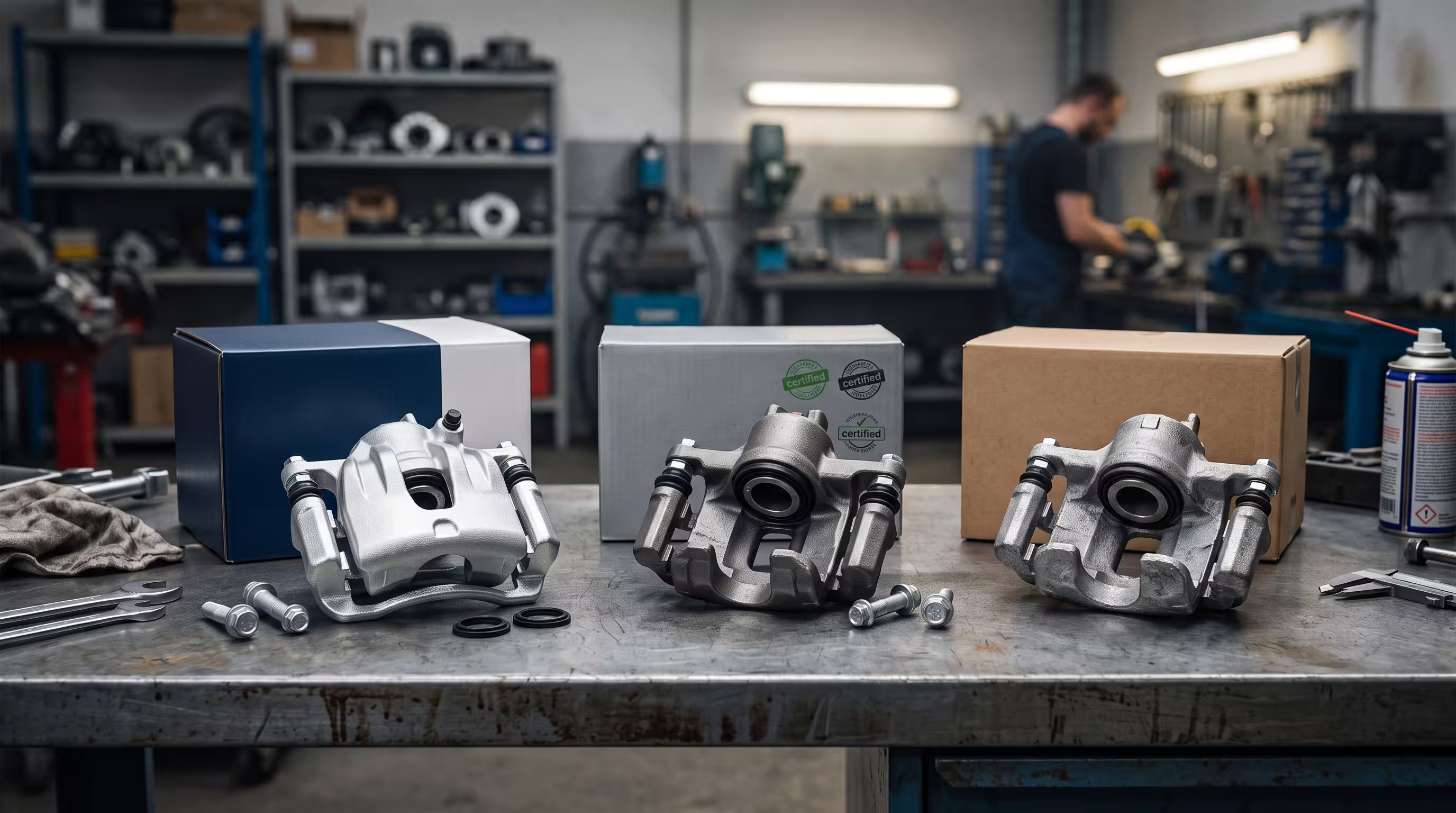
OEM vs aftermarket brake pads and rotors compared: ceramic vs semi-metallic, noise, dust, rotor wear, and when aftermarket brakes are as good as OEM. It is written for buyers, DIYers, and workshops who want clearer technical context, more reliable fitment checks, and fewer avoidable mistakes.
In this guide
Ceramic vs semi-metallic: the compound decides more than the badge
Pad compound affects noise, dust, cold-brake bite, and rotor wear more directly than whether the box says OEM or aftermarket.
Ceramic pads use a dense ceramic compound with embedded copper fibers. They run quieter, produce less visible brake dust, and are gentler on rotors, but have a lower coefficient of friction than semi-metallic pads and can feel less immediate in cold weather or before the brakes reach operating temperature. Semi-metallic pads - steel, iron, and copper fibers with friction modifiers - dissipate heat well and hold stopping power across a wider temperature range, which is why they're the standard choice for track use or heavier, faster driving, at the cost of more noise and faster rotor wear.
Most manufacturers spec ceramic-leaning compounds for daily-driver OEM pads because they prioritize a quiet, predictable, linear pedal feel - a gentle initial bite that builds progressively. That's a deliberate engineering choice, not proof that ceramic is the objectively better compound; it's the better compound for that use case. A reputable aftermarket semi-metallic pad for the same car isn't an inferior part, it's a different compound aimed at different priorities.
- Ceramic: quieter, less dust, easier on rotors, softer cold bite.
- Semi-metallic: stronger high-temperature performance, more noise, faster rotor wear.
- Match the compound to how the car is actually driven, not just to what shipped from the factory.
Where OEM pedal feel actually matters
OEM engineering advantage shows up most in pedal-feel tuning, not in raw stopping distance.
OEM brake systems are tuned as a set - pad compound, rotor mass, and caliper design are matched together during vehicle development so the pedal behaves predictably across everyday conditions. That tuning is real, and it's the strongest argument for staying with OEM-spec pads on cars where a soft, linear pedal is part of the intended driving experience, such as luxury or comfort-oriented models.
It's a narrower advantage than it sounds, though. Reputable aftermarket brands invest heavily in matching or improving on OEM pedal feel specifically because pedal complaints are the most common reason drivers reject an aftermarket brake job. The practical takeaway: OEM-spec is the safer default when you have no other information about a brand, but a well-reviewed aftermarket pad from an established brake manufacturer is not a downgrade - it's a different set of trade-offs, and on stopping distance under hard braking, many aftermarket pads test at parity with or ahead of OEM.
- OEM pad/rotor/caliper tuning is matched as a system, which shows up mainly in pedal feel.
- Reputable aftermarket brake brands are engineered to match or beat OEM pedal complaints, not just price.
- Stopping distance under hard braking is not reliably an OEM advantage - it depends on the specific pad tested.
What to check before buying either way
The label (OEM or aftermarket) matters less than verifying compound, rotor spec, and pairing.
Whichever route you take, three things determine whether the job goes well: the pad compound matches your driving style (daily commuting vs spirited or towing use), the rotor is rated for the pad you're pairing it with (mismatched pad/rotor hardness accelerates wear on both), and the part is confirmed against your exact vehicle build - caliper and rotor diameter can vary by trim and engine option even within one model year, which is exactly the kind of variation a VIN-based fitment check resolves that a generic listing won't.
Bedding-in procedure matters as much as the parts themselves: new pads and rotors need a proper bed-in cycle (a series of moderate-to-firm stops without dragging to a complete stop each time) to transfer an even friction layer onto the rotor surface. Skipping this step is a common cause of new-brake noise and uneven wear that then gets blamed on the parts rather than the installation.
- Confirm caliper/rotor diameter against your exact build spec, not just the model name.
- Pair pad hardness to rotor spec - don't mix a track-oriented pad with a stock rotor rated for daily use.
- Always bed in new pads and rotors before normal driving; most new-brake noise complaints trace back to a skipped bed-in.
Comparison table
Ceramic vs semi-metallic at a glance
| Factor | Ceramic | Semi-metallic |
|---|---|---|
| Noise | Quiet | Noticeably louder over time |
| Dust | Low, lighter colored | Higher, darker residue |
| Cold bite | Softer until warm | More consistent across temperature |
| Rotor wear | Lower | Higher |
| Best for | Daily driving, comfort-focused cars | Track use, towing, spirited driving |
Related site resources
These links point to supporting resources such as FAQs, category references, and contact forms when extra context is useful.
FAQ
Should I replace rotors when I replace brake pads?
Not always. Replace or resurface rotors if they are below the minimum thickness stamped on them, warped (pulsing pedal), or deeply scored. Many shops replace both together because new pads bed in best on a fresh rotor surface.
Are aftermarket brake pads as safe as OEM?
From a reputable brand with published friction and testing data, yes - the compound and manufacturing quality determine safety, not whether the box says OEM. Avoid unbranded, untraceable listings regardless of price.
Can I mix ceramic pads with my factory rotors?
Generally yes, as long as the rotor is rated for the pad's temperature range and the diameter/thickness matches your exact build spec. Mismatched pairings are the more common problem than compound alone.
Why do my new brakes squeal?
Most new-brake noise comes from an incomplete bed-in cycle or hardware (shims, clips) that wasn't replaced alongside the pads. Confirm bed-in procedure and full hardware kit before assuming the pads are defective.